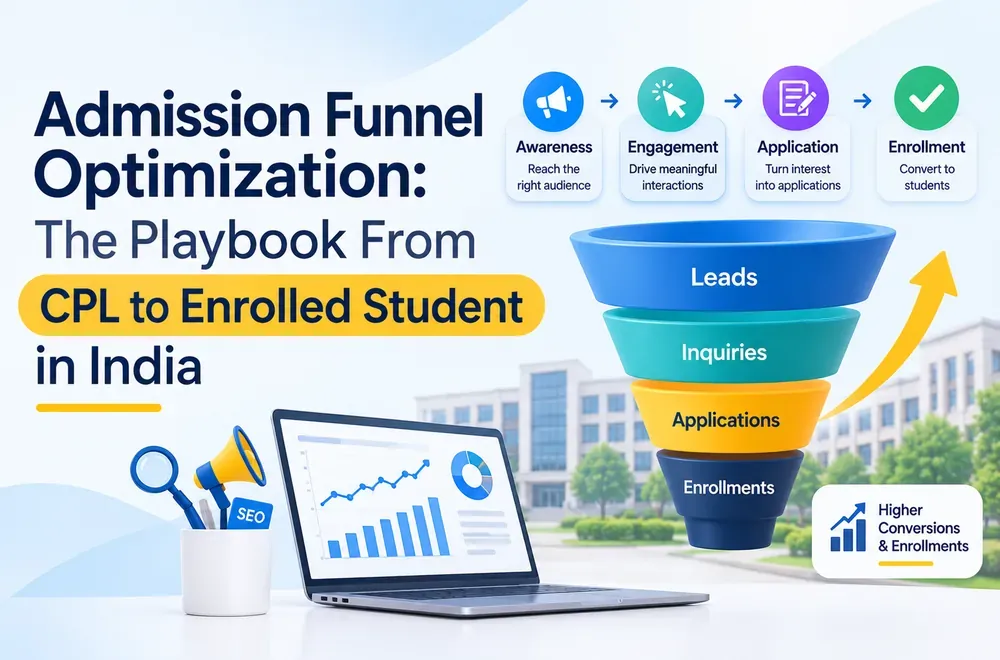
Admission funnel optimization is the practice of measuring and improving every stage between a lead arriving and a student paying their admission fee, instead of optimizing ad campaigns in isolation. For Indian institutions the funnel runs lead, contact, counselling, application, offer, fee payment, and the biggest gains almost never come from cheaper leads. They come from faster first contact, better counselling conversion, and follow-up that survives the weeks between offer and fee. This playbook walks through each stage and what to fix at it.
What is admission funnel optimization?
Admission funnel optimization is the discipline of treating admissions as one connected pipeline and working on the stage where students actually leak out. Most institutions optimize the top, pushing cost per lead (CPL) down campaign by campaign, while the real losses happen further down: leads called two days late, counselling conversations that never get a second call, applications abandoned at the fee step. Funnel work starts by measuring conversion between every stage, then spending effort where the drop is steepest.
The distinction matters because the metrics pull in opposite directions. A campaign that halves CPL by attracting casual clickers can make enrolment numbers worse, while a campaign with a higher CPL from high-intent sources can fill seats at a lower cost per enrolment. Until an institution can see cost per enrolled student by source, it is navigating with the wrong dashboard.
Done properly, funnel optimization is also an operations project, not only a marketing one. It covers how fast counsellors pick up a new lead, what happens on WhatsApp after the first call, how fee and scholarship objections get handled, and how admission season capacity is planned around intake deadlines. The sections below take the funnel stage by stage.
What does the Indian admission funnel actually look like?
Generic funnel diagrams from Western enrollment software assume application portals, rolling decisions, and email as the main channel. The Indian reality is different enough to need its own map. Leads arrive mostly from Meta lead forms, Google Search, education portals and aggregators, and walk-ins during admission season. Contact happens on phone and WhatsApp, not email. The decisive stage is the counselling call, often several of them, involving parents as much as students. Then comes the application, the offer, and a fee payment that frequently waits on an education loan, a competing exam result, or another college's merit list.
Timing is also structural. Most of the volume compresses into intake windows around board results and entrance exam cycles, which means the funnel has to perform under peak load exactly when counsellor bandwidth is scarcest. A funnel that converts well in February can fall apart in June purely because follow-up discipline collapses under volume.
Each of these stages deserves its own deep playbook, and this hub links out to them as we publish stage-level guides. What stays constant is the frame: know your conversion rate at every handoff, and fix the worst one first.
Why do leads leak between CPL and enrolment?
Across institutions the same five leaks appear again and again. One line of context, then the list.
- Slow first contact: Leads called hours or days after the form fill reach a student who has already spoken to three other colleges. Speed to lead is the single highest-leverage fix in most funnels.
- No lead qualification: Counsellors burn hours on leads who were never eligible or never serious, while qualified leads wait. Scoring leads by intent and eligibility, the shift from CPL to CPQL, fixes the queue. The full framework is in our guide on lead quality from CPL to CPQL.
- Single-touch follow-up: One call, no answer, lead marked dead. Indian admission decisions take weeks and involve families; funnels built on one attempt lose students who were still deciding.
- Counselling without structure: Calls that recite brochure points instead of handling the real objections: fees, placements, distance, parental doubts. Unstructured counselling converts on counsellor talent alone, which does not scale in season.
- Post-offer silence: The weeks between offer and fee payment are where competing offers, loan delays, and second thoughts live. Institutions that go quiet here donate admitted students to competitors.
Every one of these leaks is measurable, which is the point of the next section's stage metrics. But the first two, speed and qualification, deserve their own treatment because they compound everything downstream.
How do you fix speed to lead and follow-up?
The first hour after a form fill is worth more than the next week. A student filling enquiry forms is usually filling several in one sitting, and the institution that responds first frames the comparison for everyone who calls later. Getting there consistently is an automation problem, not a motivation problem: instant acknowledgement on WhatsApp the moment the lead lands, automatic assignment to a counsellor, and an escalation if no human call happens within a defined window. AI-driven qualification can handle the first response in under a minute and hand the counsellor a lead that has already shared course interest and city.
Follow-up after the first call is the second half of the fix. A structured sequence, calls spaced across days, WhatsApp messages carrying brochures, fee structures, scholarship deadlines, and hostel details, keeps the institution present through a family's decision without depending on any counsellor's memory. WhatsApp matters disproportionately here because it is where Indian students and parents actually reply, and because it carries documents and payment links natively. We cover the mechanics in our post on WhatsApp automation for education marketing.
The goal of all of it is simple: no qualified lead ever sits untouched, at any stage, during admission season.
How do you measure and optimize each stage?
Funnel optimization without stage metrics is guesswork, so the dashboard comes before the fixes. The minimum viable version is a weekly table: leads, contacted, counselled, applied, offered, enrolled, by source. From it, compute conversion between each adjacent pair and cost per enrolled student by source. Two patterns usually jump out within a month.
The first is that sources differ far more at the bottom of the funnel than at the top. Portal leads and Meta leads can cost the same per lead and differ three-fold in enrolment rate. Discovery channel matters too: Meritto's Enrollment Index 2026 found students who discover an institution through AI platforms are six times more likely to enrol than students from other digital channels, exactly the kind of difference a CPL-only view never surfaces. Budget should follow cost per enrolment, not CPL.
The second is that one stage is usually broken while the others are fine. A funnel losing 80 percent between contact and counselling has a scheduling and persistence problem. One losing students between offer and fee has a nurturing and objection problem. The dashboard tells you which playbook to open, and the stage-level guides in this cluster go deep on each.
When should an institution bring in a partner?
The dashboard, the follow-up sequences, and counselling structure are in-house work if the team has the bandwidth to build them. Where institutions stall is running all of it at once during season: campaigns that need daily management, automation that needs maintenance, and counsellor processes that need enforcement, simultaneously. A partner earns its place when it owns the funnel end to end rather than just the ad spend.
That end-to-end frame is how AdClear, a Google Partner agency in Noida working in education marketing since 2017, approaches admissions. Its AdClear Surge framework ties campaign fundamentals to the funnel stages above, and its AI lead nurturing responds to new enquiries in under 45 seconds, attacking the speed-to-lead leak directly before counsellors even pick up the phone. The approach has a published case study of increasing leads for educational institutions by 150 percent, with the full-funnel structure built around digital marketing for higher education rather than generic lead generation.
Want to see where your funnel leaks? Book a strategy call and we will map your stage conversion rates with you.