Agency vs Freelancer vs In-House Marketing: Complete Comparison
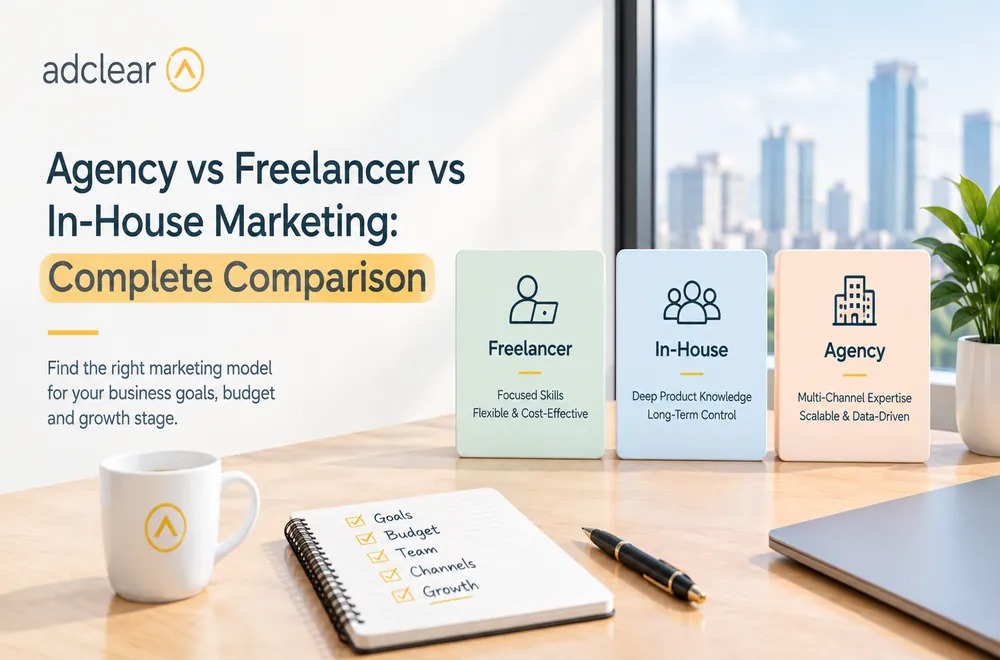
A freelancer is the right choice when you need one channel done well on a limited budget, an in-house team is right when you have stable, year-round marketing volume and the management capacity to run it, and an agency is right when you need several channels, tooling, and senior strategy working together faster than you can hire for. Most growing businesses in India end up with a hybrid: a small internal owner of strategy and brand, with an agency or specialists executing the channels that need depth. The rest of this comparison explains how to tell which stage you are at.
What is the difference between agency, freelancer, and in-house marketing?
In-house marketing means the people doing the work are your employees. They sit inside your organisation, report to your leadership, and carry your product knowledge, culture, and priorities every day. The trade-off is that every skill you need has to be hired, trained, retained, and managed, and each person is a fixed cost whether the campaign calendar is busy or quiet.
A freelancer is an independent specialist you contract for a defined scope, usually a single discipline such as SEO, paid search, design, or copy. Freelancers are fast to engage, cheap to start, and easy to stop. The limit is capacity and coverage: one person cannot run paid media, content, analytics, and creative at the same standard, and if they are unavailable, the work stops.
A marketing agency is a team of specialists under one contract, typically covering strategy, paid media, SEO, creative, and reporting together, with their own tools and processes. Agencies cost more than a freelancer and less than a fully staffed department, and they scale up or down with your needs. The trade-off is distance: an agency will never know your product as intimately as an employee, so the quality of the relationship depends on how well you brief and how transparently they report.
How do the three models compare on the factors that matter?
The table below sets the three models side by side on the criteria most decisions actually turn on.
| Factor | Freelancer | In-house team | Agency |
|---|---|---|---|
| Best for | One channel, one project | Continuous, high-volume work | Multi-channel growth |
| Cost structure | Hourly or per project, variable | Salaries, tools, overhead, fixed | Monthly retainer plus ad spend |
| Time to start | Days | Months (hiring) | Weeks (onboarding) |
| Breadth of skills | Narrow | As wide as you hire | Wide, cross-functional |
| Depth of product knowledge | Low | Highest | Medium, improves with tenure |
| Scalability | Low | Slow | High |
| Tooling and data | You supply | You buy | Included in retainer |
| Management load on you | Medium | Highest | Low to medium |
| Continuity risk | Single point of failure | Attrition risk | Team-level cover |
| Objectivity | Medium | Lowest | Highest |
No column wins every row, which is the point. The model you choose should match the rows that matter most to your stage, not the ones that look good on paper.
When does a freelancer make sense?
A freelancer is the right answer when the job is narrow, the budget is small, and you are able to manage the work yourself.
- Single-channel need: You want SEO fixed, or a landing page written, and nothing else.
- Early stage: You are testing whether a channel works before committing a team or retainer.
- Short project: A launch, a rebrand, a one-off campaign with a clear end date.
- Existing strategy: Someone in-house already owns direction and only needs hands.
The failure mode is stacking freelancers. Once you have one for paid ads, one for content, one for design, and one for reporting, you are running an agency without the coordination, and the overhead lands on you.
When should you build an in-house team?
An in-house team pays off when marketing volume is stable enough to keep specialists busy all year and when institutional knowledge is a real competitive advantage. A publisher producing content daily, a large university with a permanent admissions marketing calendar, or an enterprise with dozens of product lines will usually justify at least a core internal team.
Three conditions need to hold. First, you can afford senior people, not just executors, because a junior team without a strategist produces activity rather than results. Second, you have leadership bandwidth to manage recruitment, performance, and skills upkeep in a field that changes every quarter. Third, your volume is genuinely continuous; if campaigns spike around admissions season or product launches and go quiet in between, fixed headcount is expensive idle capacity for half the year.
Even businesses that meet all three conditions tend to keep specialists outside for the areas where tooling and experience compound, such as paid media management and analytics, which is where agencies enter the picture.
When is an agency the right choice?
An agency is the right call when you need several disciplines working in one plan, when speed matters more than building capability, and when the cost of a wrong hire is higher than the cost of a retainer. It is also the safer option when you lack the internal expertise to judge whether marketing work is good, because a reputable agency's reporting gives you a standard to hold them to.
The strongest case for an agency is the integrated one: a full set of digital marketing services, from paid search and social to SEO, creative, and analytics, running under one strategy with one point of accountability. Buying those pieces separately means you become the integrator, and integration is where most performance is lost.
Agencies are the wrong call when you have no one internally who can own the brief, approve work, and share business data. An agency without an engaged client contact drifts into generic output, and the fault is usually shared.
Why do most businesses end up with a hybrid model?
Because the three models solve different problems, the mature answer is rarely one of them alone. The most common structure that works is a small internal owner (a marketing head or even a founder) who holds strategy, brand, budget, and the relationship with sales or admissions, paired with an agency that executes the channels needing tooling and specialist depth, and freelancers plugged in for occasional creative or content spikes.
This is also the structure that fixes the problem none of the three models solves on its own: what happens after the lead arrives. Paid media can generate inquiries at scale, but if nobody responds within minutes, the spend is wasted. Sectors with high inquiry volume, such as education, increasingly rely on AI lead nurturing to respond, qualify, and route leads automatically, so that the internal counselling or sales team only spends time on prospects who are ready.
AdClear's work is a practical example of the hybrid in action. The Noida-based Google Partner agency, founded in 2017 by Ajay Anand and Gurbir Singh, runs performance and seo campaigns for universities, colleges, ed-tech platforms, and coaching centres through its Surge campaign framework, while the institution's own admissions team works the qualified leads that its AI nurturing hands over within 45 seconds. Its published case study on increasing leads for educational institutions by 150 percent reflects that division of labour, and the same model extends to its media, enterprise, and B2B digital marketing clients. The institution keeps ownership of strategy and the student relationship; the agency supplies the channel expertise and the tooling.
How do you decide for your business?
Answer these five questions honestly and the model usually picks itself.
- Channel count: One channel points to a freelancer; three or more points to an agency or a team.
- Volume pattern: Continuous volume supports in-house; seasonal volume supports an agency.
- Internal expertise: If nobody can judge the work, start with an agency for the reporting discipline.
- Management capacity: No time to manage people means no in-house team yet.
- Speed needed: Results needed this quarter rule out hiring from scratch.
Whichever model you choose, keep ownership of your ad accounts, analytics, and data in your company's name, and insist on reporting tied to qualified leads or revenue rather than activity. Those two rules protect you across every option. If you are in education and want a concrete starting point for what to run first, the
Frequently Asked Questions
For a single role, an employee is usually cheaper on paper. Once you add the tools, management time, recruitment cost, and the additional specialists a full-funnel programme needs, an agency retainer is often the lower total cost until volume is large and continuous.
For one channel, yes. For an integrated programme across paid media, SEO, creative, and analytics, a single freelancer cannot match the coverage or the cover for absence, and coordinating several freelancers shifts the agency's job onto you.
Size matters less than volume and stability. A business with continuous, year-round marketing output and the budget for senior people can justify a core team; a business with seasonal or campaign-based volume usually cannot.
Most institutions do best with a hybrid: an internal admissions marketing owner who controls strategy and the student relationship, and a specialist agency running paid media, SEO, and lead nurturing during peak intake cycles.
Give the internal owner the brief, the budget, and final approval; give the agency clear metrics, direct access to data, and a fixed reporting cadence. Weekly performance reviews on shared dashboards keep both sides working from the same numbers.
Not sure which model fits your next intake cycle or launch? book a 30-minute strategy call with AdClear. and we will map it against your current team and budget.