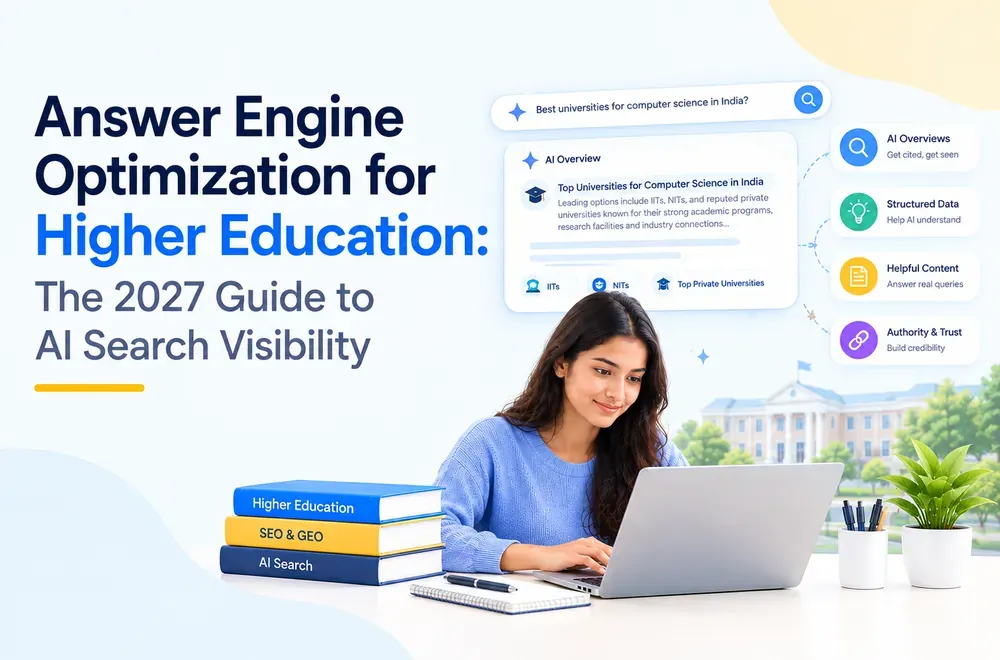
Answer engine optimization (AEO) for higher education is the practice of structuring your institution's content, entities, and third-party presence so AI platforms like ChatGPT, Gemini, Perplexity, and Google AI Overviews cite your institution when students ask questions about courses, fees, placements, and admissions. In 2027 this matters because a growing share of Indian students begin their college search inside an AI chat instead of a search results page, and the institutions those answers name are shaping shortlists before a website visit ever happens.
What is answer engine optimization for higher education?
Answer engine optimization is the discipline of earning a place inside AI-generated answers rather than a position on a results page. A search engine ranks ten blue links and lets the student choose. An answer engine reads its sources, composes one response, and names only a handful of institutions in it. AEO is everything an institution does to be one of the names in that response, and to be described accurately when it appears.
For a university, college, or ed-tech platform, that means three layers of work. The first is on-site: program pages, fee pages, and admissions FAQs written so an AI model can lift a clean, factual answer from them. The second is structural: schema markup, consistent entity information, and a site architecture that makes your institution legible to machines. The third is off-site: the rankings, directories, news coverage, and review platforms AI models actually read when they compare institutions, because answer engines lean heavily on third-party sources rather than your own website alone.
AEO does not replace SEO. The two share most of their foundations, and a site that cannot rank rarely gets cited. What changes is the finish line. SEO ends at a click. AEO ends at a mention inside an answer, with or without a click attached.
Why does AEO matter for student recruitment in 2027?
The behaviour shift is showing up in enrollment data. EAB's February 2026 survey of more than 5,000 school students found that 46 percent now use AI tools such as ChatGPT during their college search, up from 26 percent in spring 2025, and 18 percent removed a college from consideration based on information surfaced in AI results. Students are not only discovering institutions through AI, they are eliminating them there too.
The Indian data is sharper still. Meritto's Enrollment Index 2026 reports that students who discover an institution through AI platforms are six times more likely to enrol than students arriving through other digital channels. The same shift shows up in traffic: an analysis of nine leading public universities found organic search traffic fell more than 35 percent between August 2024 and April 2026 as AI answers absorbed queries that once produced clicks. For study abroad, a Leap Scholar report found around 75 percent of Indian students now use AI tools to choose their programmes.
AI-sourced students convert better, arrive better informed, and are being won or lost in conversations your analytics cannot see. The institutions that treat this as a channel now are competing against very few others, because most Indian colleges have not started.
How is AEO different from traditional SEO for institutions?
The overlap is larger than most vendors admit. Crawlable pages, clear headings, and genuine authority help in both systems, and strong rankings remain one of the signals answer engines use when choosing sources. An institution with weak SEO has no shortcut into AI answers.
The differences sit at the margins, and they are the margins that decide citations. Answer engines reward content that answers a question completely in one place. They lean on third-party validation far more than ranking algorithms do, so what NIRF listings, news coverage, and review platforms say about you can outweigh your own copy. And they respond to specificity: a page stating exact fees, placement figures, and eligibility gets quoted, while brand language about holistic excellence gets skipped. There is also a measurement difference. Rankings can be tracked in Search Console; AI citations largely cannot, which is why the playbook below starts with an audit rather than with content.
How do answer engines decide which institutions to cite?
Models like ChatGPT and Gemini build answers from training data, live retrieval, and the sources they trust for a topic. For higher education queries, a few patterns hold.
- Entity clarity: The model must know exactly who you are: official name, location, accreditations, programmes, and how they connect. Inconsistent NAP details or conflicting programme names across pages blur the entity and cost citations.
- Extractable answers: Direct question-and-answer formatting, clean headings, and FAQ and Organization schema give models liftable facts instead of marketing prose.
- Third-party corroboration: Answer engines cross-check. Presence in rankings, education directories, news stories, and review platforms confirms your claims and supplies the comparative language models repeat.
- Topical depth: A cluster of pages covering one programme area thoroughly beats scattered thin pages, because depth reads as authority on that subject.
- Freshness: Fee, date, and placement figures carry years. Stale numbers either get skipped or, worse, quoted.
None of these are exotic. They are the same fundamentals behind strong digital marketing for higher education, applied with an answer engine reading over your shoulder. What is new is deliberately engineering for them, which is what the playbook below does.
What does an AEO playbook for Indian institutions look like?
A realistic programme for an Indian university or college runs in five moves, roughly in this order.
- Audit first: Ask ChatGPT, Gemini, and Perplexity the questions your prospective students ask: best B.Tech colleges in your city, your institution's placements, fees, comparisons with rivals. Record what the AI says, which sources it cites, and where you are absent or misdescribed. This baseline is the whole strategy's foundation.
- Fix entities: Standardise your institution's name, address, programmes, and accreditations everywhere they appear: website, Google Business Profile, Wikipedia if eligible, directories, and social profiles. Add Organization, Course, and FAQ schema.
- Rebuild key pages: Rewrite your highest-intent pages, usually programme and fee pages, in answer-first format: the direct answer at the top, specifics in the body, one page per real question. Prioritise the pages your audit showed AI getting wrong.
- Earn third-party presence: Pursue the sources your audit showed AI citing: education portals, rankings coverage, local news, Quora and Reddit threads, review platforms. Seeding accurate information into the sources models read is often faster than waiting for models to re-crawl your site, and the mechanics are covered in our guide to LLM seeding strategies for AI visibility.
- Re-test quarterly: Re-run the audit prompts every quarter, track changes in how models describe you, and watch AI referral traffic in analytics. Treat it like rank tracking for a channel that has no rank tracker.
Most institutions can complete the first two moves in a month with existing staff. The later moves are where content capacity and outreach decide pace.
How do you measure AI search visibility?
Measurement is the least mature part of AEO, but three practical signals exist today. The first is the prompt audit itself, repeated on a fixed schedule with fixed questions, which turns anecdote into a trackable share-of-voice number: out of twenty priority questions, how many answers name you, and how accurately. The second is referral traffic from AI surfaces, since ChatGPT, Perplexity, Gemini, and Copilot pass identifiable referrers that analytics can segment. The third sits in your funnel: admissions teams that log the source of first discovery increasingly hear AI recommendations named. Expect small numbers at first. The point is direction, not volume, because the behaviour driving them compounds each admission cycle.
When should an institution bring in specialist help?
The audit, entity cleanup, and quarterly re-testing are genuinely in-house jobs. Where institutions stall is the middle of the playbook: rewriting dozens of programme pages in answer-first format, building content clusters, and running sustained third-party outreach, all while admission season campaigns still need to run. That combination of SEO, content, and PR muscle is where a specialist partner earns its fee.
If you go that route, look for education-sector evidence rather than generic AEO promises. AdClear, a Google Partner agency in Noida, has worked in higher education marketing since 2017 across universities, colleges, ed-tech platforms, and coaching centres, with clients including RIT Roorkee and Middlesex University, and a published case study of increasing leads for educational institutions by 150 percent. Its AdClear Surge framework pairs campaign fundamentals with AI lead nurturing that responds to inquiries in under 45 seconds, which matters because AEO brings you the student and speed-to-lead keeps them.
AEO also cannot stand alone. The institutions winning AI citations are the ones whose search foundations were already in order, which is why pairing this guide with the fundamentals of higher education SEO for student recruitment is the right next read.
Ready to see what AI currently says about your institution? Book a strategy call and we will run the first audit with you.