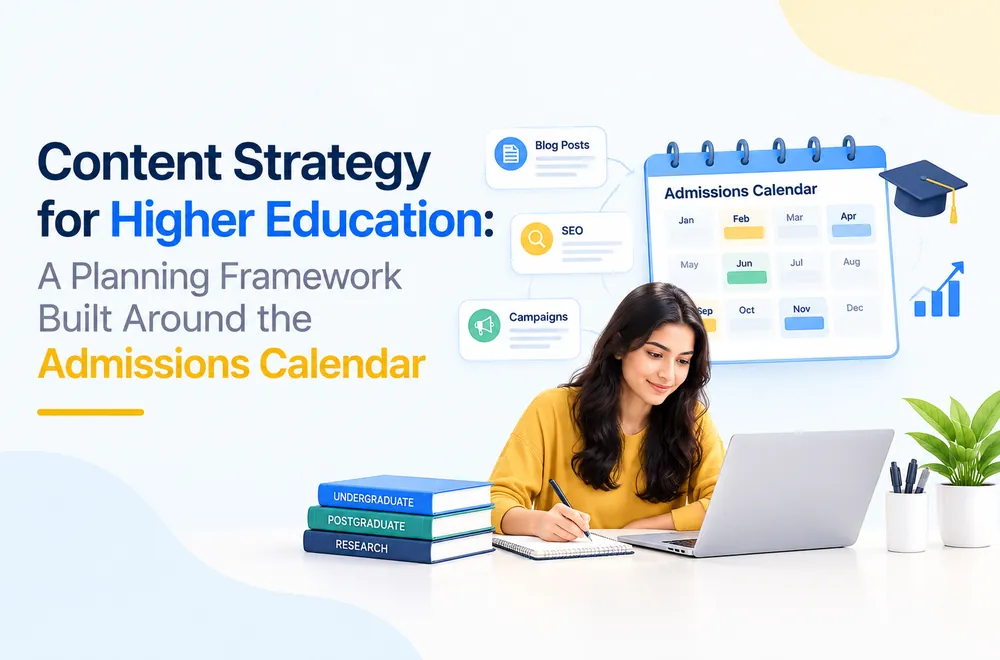
A content strategy for higher education is a documented plan that decides which questions your institution will answer, for which audience, on which channels, and at what point in the admissions year. The strongest plans are built backwards from the admissions calendar. Discovery content goes live months before results season, comparison and fee content peaks while families shortlist, and onboarding content takes over after the seat is confirmed, so every piece has a job tied to an enquiry, an application or an enrolment.
What is a content strategy for higher education?
Content marketing is the production of blogs, videos, reels and emails. Content strategy is the set of decisions above it: who the content is for, which questions it must answer, which channels carry it, who approves it and how success is measured. Without that layer, colleges publish steadily and still wonder why enquiries do not move.
In Indian higher education, the strategy has to account for a shared decision. Students research programs, campus life and careers, while parents scrutinise fees, placements, safety and return on investment, often searching in Hindi or a regional language. The decision is also compressed: months of quiet research turn into a few intense weeks after board and entrance results.
A working content strategy is therefore less a list of topics and more a map. Every asset is tied to a question, the person asking it, a stage in the admissions year and a metric that shows whether it did its job. The admissions calendar holds that map together.
Why should the admissions calendar drive your content plan?
Student demand is seasonal, but content performance is not instant. A program page or comparison guide published in the middle of counselling season is usually too late, because search rankings and AI answer visibility take months to build. The content that wins in May was planned in October and published by December.
The calendar has also become more complex. Since the 2024-25 session, the UGC has allowed institutions to admit students twice a year, in July-August and January-February, for those with the faculty and infrastructure to do so. Colleges running both intakes are effectively managing two overlapping content cycles, which makes a written calendar essential rather than optional.
Planning backwards solves both problems. Start from the dates that matter, such as application opening, entrance results, counselling rounds, fee deadlines and the first day of classes, and schedule each content type to go live early enough to be found when that moment arrives.
How do you map content to each admissions stage?
Each stage of the admissions year carries a different question, so each needs a different type of content. The table below uses a typical July intake; shift the timing by roughly six months for a January intake.
| Stage |
Typical timing |
What families are asking |
Content that answers it |
What to measure |
| Discovery |
September to December |
Which course, which career, which city? |
Career guides, course explainers, "scope of" articles, short videos |
Organic sessions, newsletter and WhatsApp opt-ins |
| Shortlisting |
January to April |
Is this college good enough, and is it worth the fee? |
Program pages, placement reports, fee and scholarship guides, comparison pages |
Enquiries by entry page, brochure downloads |
| Decision |
Results to counselling |
Can we trust them, and what happens next? |
Admission process walkthroughs, parent FAQs, campus and hostel videos, live Q&A sessions |
Applications started and completed |
| Onboarding |
Fee payment to first day |
Did we choose right, and what do we do now? |
Joining checklists, hostel guides, orientation content, student community invites |
Seat confirmation, drop-off rate before joining |
A parent track runs alongside all four stages. Parents look for fee breakdowns, loan options, placement medians and hostel safety, and pages written plainly for them, in the languages they search in, remove the objections that stall late decisions.
Also Read: Email Marketing for Higher Education: A Stage-by-Stage Playbook for Indian Admissions
Which content pillars should a college build first?
Most institutions get the best return from building a small set of pillars properly before spreading into trend pieces and social content.
- Program pages: curriculum, eligibility, fees, intake dates and outcomes on one page, since this is where most enquiries convert.
- Outcome proof: placement reports with medians, recruiter names and year-wise data, plus alumni stories that name real roles.
- Fees and finance: total cost of study, scholarships, instalment options and education loan guidance.
- Comparison content: course-versus-course and career-path pieces that meet students while they are still undecided.
- Campus reality: hostel, safety, faculty and student life, shown through video rather than described in adjectives.
- Parent guides: a dedicated section that answers the questions parents ask, in their language.
These pillars only earn traffic when they are structured for search and kept technically sound. Our guide on why higher education SEO is no longer optional for student recruitment covers that foundation in detail.
How should content be built for AI answers and search?
Search behaviour among students has shifted toward conversational questions. Google introduced AI Mode in India in June 2025 and has since added Hindi, and the company reports that queries in AI Mode run two to three times longer than traditional searches. A student who once typed "BBA colleges Noida" now asks which BBA programs near Noida have strong placements under a specific fee range.
That changes how content should be written. Lead each section with a direct answer, then support it. Publish checkable facts such as fees, intake dates, eligibility and placement medians, because AI systems prefer citing precise information over promotional language, and keep those facts identical across your website, Google Business Profile and directory listings.
FAQ sections, comparison tables and clearly labelled data help both rankings and AI answers, while Hindi and regional-language versions of fee and admission pages reach parents who never search in English.
Who should own and govern the content plan?
A content strategy fails most often not on ideas but on ownership. Facts change every year, approvals stall, and pages quietly go out of date. A light governance model prevents that.
- Content owner: one person accountable for the calendar, publishing and refresh schedule.
- Subject experts: faculty, the placement cell and admissions staff who supply and verify facts.
- Claims approver: a senior sign-off for anything involving fees, placements, rankings or accreditations.
- Annual refresh: a fixed date before each cycle opens to update every fee, date and eligibility detail.
With ownership settled, the remaining question is whether the content is actually producing students.
How do you measure whether content is working?
Page views, time on page and social shares show reach, not results. The measures that matter connect content to admissions. Track which entry pages generate enquiries, how many of those enquiries start and complete applications, and which content types appear in the paths of students who eventually enrol.
The most useful single number is the cost of a lead that admissions would actually call back. Our framework on moving from CPL to CPQL explains how to define a qualified lead and measure it consistently. Once that definition exists, content can be judged on the quality of enquiries it produces, not just the volume.
Practically, this means passing the source page into every enquiry form through hidden fields or UTM parameters, setting up key events in GA4 for application starts and completions, and reviewing results by stage each month during the cycle.
When should you bring in an agency?
In-house teams do well when one person owns the calendar, the facts and the measurement. Outside help makes sense when content has no link to enquiry data, when two intakes stretch the team, or when parent-facing and regional-language content keeps slipping.
AdClear is a Google Partner agency in Noida that specialises in digital marketing for higher education, working with universities, colleges, ed-tech platforms and coaching centres including RIT Roorkee, Delhi School of Communication and Middlesex University. Content plans are built inside the AdClear Surge model, which ties every piece to enquiry and admission data, and the same full-funnel approach produced a published 150 percent increase in leads for educational institutions.
Book a 30-Minute Strategy Call