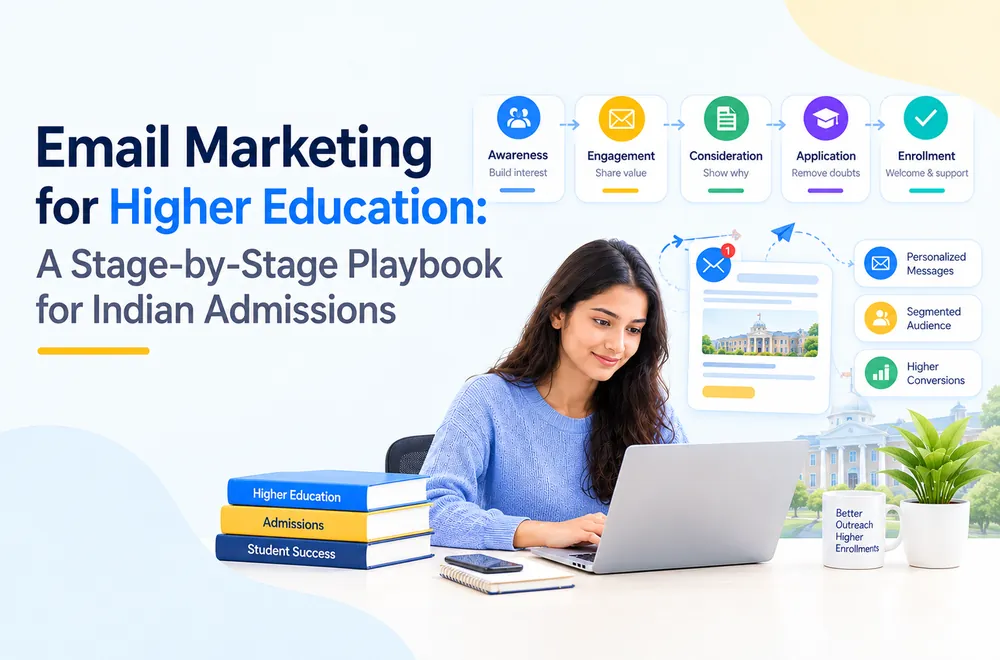
Email marketing for higher education works best as a stage-based system rather than a monthly newsletter. That means an instant reply when an enquiry arrives, a short nurture sequence while the student compares options, deadline and document reminders during applications, and an onboarding series once the seat is confirmed. In India, email carries the detail that families need to keep and forward, such as brochures, fee structures and offer letters, while WhatsApp handles quick conversations, so the two channels should be planned together.
What role does email play in higher education marketing?
Email is the channel of record in admissions. Social media and WhatsApp start conversations, but the documents families rely on when making a decision usually arrive by email: the program brochure, the fee schedule, the scholarship terms, the offer letter and the joining checklist. These are messages that get saved, searched later and forwarded to a parent or relative, which gives email a lasting role that faster channels do not replace.
It is also one of the most cost-efficient channels an institution owns. Litmus research has put email's average return at about 36 dollars for every dollar spent, a cross-industry figure rather than an education benchmark, but a useful reminder that the cost of sending is tiny compared with the cost of acquiring the lead in the first place. Every enquiry that arrives from paid campaigns, fairs or organic search has already cost money, and email is how much of that investment is protected.
The limitation is that email only works when it is timely, relevant and actually delivered. Generic newsletters sent to an entire database ignore where each student is in the admissions process. The rest of this playbook is organised around those stages.
What emails should you send at each admissions stage?
Each stage calls for a different message, a different tone and a different next step.
Enquiry received
Send a confirmation within minutes, while the student is still on your website or comparing tabs. Include the brochure for the program they enquired about, the fee range, the next intake date and a named contact in admissions. A slow first reply is one of the most common reasons warm leads go cold.
Comparing options
Over the following two to three weeks, send three to five short emails that answer the questions students ask while shortlisting: placement outcomes, faculty, campus and hostel life, scholarships and how your program differs from similar ones. Segment by program interest so an engineering applicant is not reading about the MBA.
Applications open
Switch to action-focused messages. Announce when applications open, send document checklists, remind students of entrance test or interview dates, and follow up automatically when an application is started but not finished. Each email should have one clear call to action.
Offer to enrolment
Once an offer is made, the risk is losing the student to another institution before the fee is paid. Send the offer details clearly, explain the fee payment process and deadlines, share scholarship or instalment options, and include a short message from a faculty member or current student.
After admission
Onboarding emails reduce drop-off between fee payment and the first day. Cover hostel allocation, required documents, orientation dates, travel guidance and an invitation to the incoming student community.
How should email and WhatsApp split the work?
In India, most students and parents respond faster on WhatsApp than on email, but the two channels do different jobs. Treating them as competitors usually leads to duplicate messages and annoyed families.
| Job |
Better on email |
Better on WhatsApp |
| Brochures, fee structures, offer letters |
Yes, saved and forwarded |
Short summary with a link |
| Instant replies to questions |
Slower |
Yes |
| Deadline and document reminders |
Yes, with full detail |
Yes, as a short nudge |
| Parent-facing information |
Yes, for detailed documents |
Yes, for quick updates |
| Counsellor conversations |
Rarely |
Yes |
A practical rule is to put the detail in email and the nudge on WhatsApp. Since July 2025, WhatsApp also charges per marketing message in India, which makes it sensible to reserve paid broadcasts for qualified leads. Our guide to WhatsApp automation for education shows how to design those conversational flows alongside your email sequences.
How do you keep admissions emails out of spam?
Deliverability is now a technical requirement rather than a best practice. Gmail and Yahoo began enforcing bulk sender rules in February 2024 for senders of roughly 5,000 or more messages a day, Microsoft followed for Outlook.com and Hotmail addresses in May 2025, and from November 2025 Gmail began permanently rejecting non-compliant mail rather than only delaying it. Institutions sending large volumes during peak season need to meet these rules.
- Authenticate domains: set up SPF, DKIM and a DMARC record for every sending domain.
- One-click unsubscribe: include a compliant unsubscribe header and honour requests within two days.
- Watch spam rates: keep complaints below 0.1 percent and never let them reach 0.3 percent.
- Separate subdomains: send marketing email from a subdomain so transactional mail stays protected.
- Warm up volume: increase sending gradually before the admissions peak instead of all at once.
- Clean lists: remove addresses that bounce or have not engaged in months.
Consent matters too. Under India's DPDP Rules, detailed consent notice requirements and verifiable parental consent for data of anyone under 18 take effect in May 2027, which affects many Class 12 applicants. Collect clear, recorded consent at the point of enquiry and make unsubscribing as easy as subscribing.
How should you write admissions emails for parents?
Parents are often reading the same inbox, or are forwarded the important emails. They want different information, presented differently. Lead with facts: total cost of study, payment schedule, scholarship eligibility, placement medians, hostel safety and who to call with a problem. Avoid slogans and stock phrases that sound like advertising.
Where possible, send a dedicated parent version of key emails, particularly the offer and fee emails, and offer it in Hindi or the family's regional language. A clear fee breakdown that a parent can understand without a phone call removes one of the biggest reasons offers are not accepted.
Which email metrics actually matter?
Open rates have become unreliable since Apple's Mail Privacy Protection began pre-loading emails in 2021, which inflates opens for anyone using the Apple Mail app. They are still useful for spotting sudden deliverability drops, but they should not decide whether a sequence is working.
Measure instead what each stage is meant to achieve: click-through to the application form, applications started and completed from each sequence, replies to admissions staff, offer acceptance rate and drop-off between fee payment and joining. Track unsubscribe and spam complaint rates as warning signals.
The strongest view connects email activity back to lead quality. Our framework for moving from CPL to CPQL explains how to judge enquiries by whether they are worth a callback, and the same lens works for deciding which email sequences deserve more investment.
When should you bring in an agency?
Email in admissions breaks down when sequences are written once and never revisited, when the CRM and email platform are not connected, or when the first reply to an enquiry depends on someone being at their desk. These are system problems, and fixing them usually takes both technical setup and admissions experience.
AdClear is a Google Partner agency in Noida that specialises in higher education marketing, with clients such as RIT Roorkee, Delhi School of Communication and Middlesex University. Its AI lead nurturing responds to and qualifies enquiries in under 45 seconds, with WhatsApp and email automation built around each admissions stage, part of the full-funnel approach behind a published 150 percent increase in leads for educational institutions.
Book a 30-Minute Strategy Call