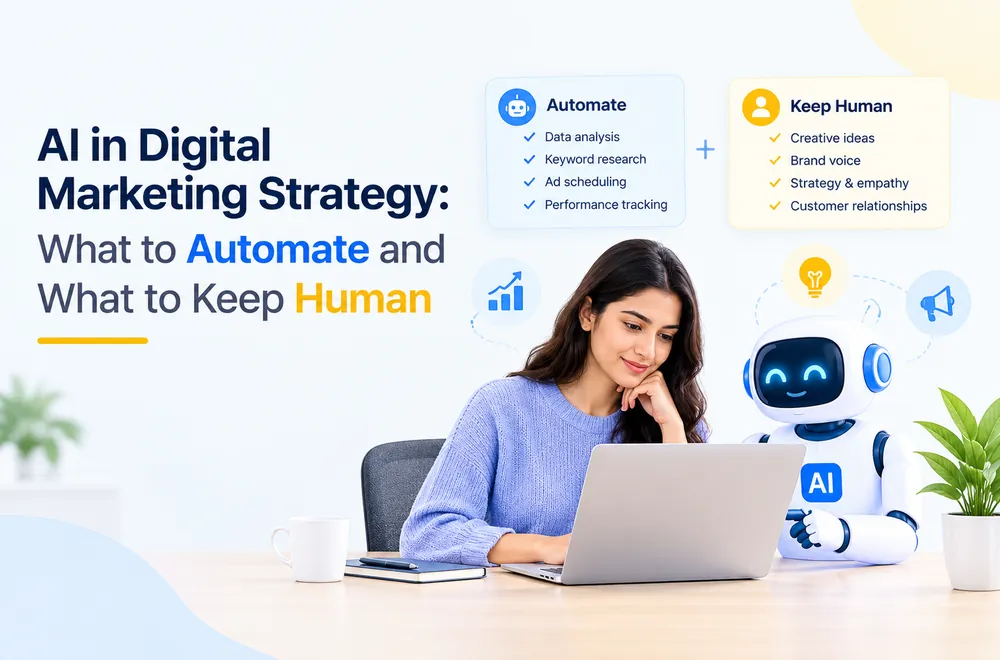
AI in digital marketing strategy is the decision about which parts of your marketing a machine should run and which parts people must own. AI is now strongest at high-volume, measurable work such as bidding, audience expansion, creative variations, first responses to leads and performance reporting. People still need to own positioning, the definition of a good customer or lead, the claims made in ads and content, budget allocation across channels, and the judgment calls the data cannot make. The strategy lies in drawing that line deliberately instead of letting each platform draw it for you.
What does AI in digital marketing strategy actually mean?
For most businesses, AI is no longer a separate tool to evaluate. It is built into the platforms they already use. Google's ad campaigns choose search terms and rewrite headlines, Meta's campaigns choose audiences and placements, email and CRM tools score leads, and search engines answer questions with AI-written summaries. The question has shifted from whether to use AI to how much control to hand over, and where.
Adoption is not the gap. McKinsey's 2025 global survey on the state of AI found that 88 percent of organisations now use AI in at least one business function, yet only 7 percent say it is fully scaled across the organisation. Most companies are using AI in pockets, often because a platform switched it on, without a strategy for what it should and should not decide.
A useful AI marketing strategy therefore does three things. It assigns tasks to automation where volume and speed matter, it reserves decisions for people where context and accountability matter, and it controls the inputs that automated systems learn from. That third part is where most of the value is won or lost.
Which marketing tasks should you hand to AI?
These are tasks where AI consistently outperforms manual work because they involve large volumes of data and fast decisions.
- Bid management: adjusting bids by user, device, time and context in real time.
- Audience expansion: finding new prospects who resemble your best customers.
- Creative variations: producing and testing headline, image and format combinations at scale.
- Lead first response: replying to and qualifying new enquiries within seconds, at any hour.
- Reporting and alerts: summarising performance and flagging unusual changes in spend or results.
- First drafts: outlining content, ad copy and email variants for a human to edit.
The common thread is that each task has a clear, measurable outcome the system can learn from. When that outcome is defined poorly, automation simply gets very efficient at the wrong goal, which is why the next list matters as much as this one.
Which decisions should stay human?
Some decisions depend on context that does not exist in the data, or carry accountability a platform cannot take.
- Positioning: what you stand for, who you are for and how you differ from competitors.
- Success signals: what counts as a qualified lead or a valuable customer.
- Claims and offers: pricing, guarantees, outcomes and anything that could mislead.
- Budget split: how much goes to each channel, market and stage of the funnel.
- Brand voice: tone, cultural judgment and what the brand will not say.
- Compliance: consent, data handling and sector-specific rules.
An education institution, for example, can let Google and Meta find prospective students, but it must decide that a "lead" means a student who meets eligibility and can afford the fee, not anyone who fills a form. A B2B software company can automate outreach, but a person needs to decide which accounts are worth pursuing.
How is AI changing search and paid media?
The two largest marketing channels have both moved toward AI-led systems, in different ways.
Search visibility
Search is shifting from a list of links to an AI-written answer. Google launched AI Mode in India in June 2025 and later added Hindi, and says queries there run two to three times longer than traditional searches. For brands, ranking first matters less if the answer is summarised above the results. Being cited depends on clear, factual, consistent information across your site and the sources AI systems trust. Our article on AI in higher ed SEO shows how this plays out in a sector where search drives most first contact.
Paid media buying
Google's AI Max for Search campaigns, rolled out in beta from May 2025, expand keyword matching, generate ad text from landing pages and choose the destination page. Google reported early testers saw 14 percent more conversions or conversion value at a similar cost per acquisition. Meta has made its Advantage+ automation the default for sales, app and leads campaigns and says early tests of Advantage+ leads campaigns produced a 10 percent lower cost per qualified lead.
The trade-off is visibility. As platforms automate, advertisers see less of how decisions are made, which makes campaign structure and conversion data more important than manual settings. Our explainer on Performance Max vs Smart campaigns covers how to keep control inside Google's most automated campaign type.
How do you build an AI-ready marketing strategy?
The sequence below works across industries and moves from foundations to optimisation.
- Fix measurement first. Make sure every conversion is tracked accurately, because AI systems learn only from the data you send.
- Send outcomes back. Upload offline conversions such as qualified leads, sales or admissions so platforms optimise for value, not volume.
- Define qualified leads. Agree with sales or admissions on the criteria, and use it as the goal everywhere.
- Feed creative volume. Give automated campaigns enough distinct images, videos and messages to test.
- Set guardrails. Use brand exclusions, negative keywords, budget caps and approval steps for generated copy.
- Test with holdouts. Compare automated campaigns against controlled setups before shifting the full budget.
What are the risks of relying on AI in marketing?
The biggest risk is optimising for the wrong signal. If a platform is told every form fill is a conversion, it will deliver large numbers of cheap, low-quality leads and report success. The fix is better inputs, not less automation.
Other risks are quieter. Automated reporting can hide which audiences or placements are driving results. AI-generated copy can state things that are untrue or that your legal team would never approve. Content produced at scale without editing tends to sound like everyone else's. Data use carries legal weight too: in India, the DPDP Rules make detailed consent notices and verifiable parental consent for under-18 users enforceable from May 2027, which affects how audiences can be built and targeted. Each of these risks is manageable when a person owns the decision AI is feeding into.
When should you bring in an agency?
Businesses usually benefit from outside support when campaigns have been automated but results have not improved, when the team cannot see what is driving performance, or when conversion tracking does not reflect real revenue or qualified leads. Those are setup and strategy problems more than tool problems.
AdClear is a Noida-based Google Partner agency offering digital marketing services across higher education, media and publishing, corporate and enterprise, and B2B growth-stage businesses, with clients including The Hindu Group, Network18 and Middlesex University. Its AdClear Surge model and AI lead nurturing, which qualifies enquiries in under 45 seconds, are built around feeding platforms the right signals, the approach behind a published 150 percent increase in leads for educational institutions.
Book a 30-Minute Strategy Call