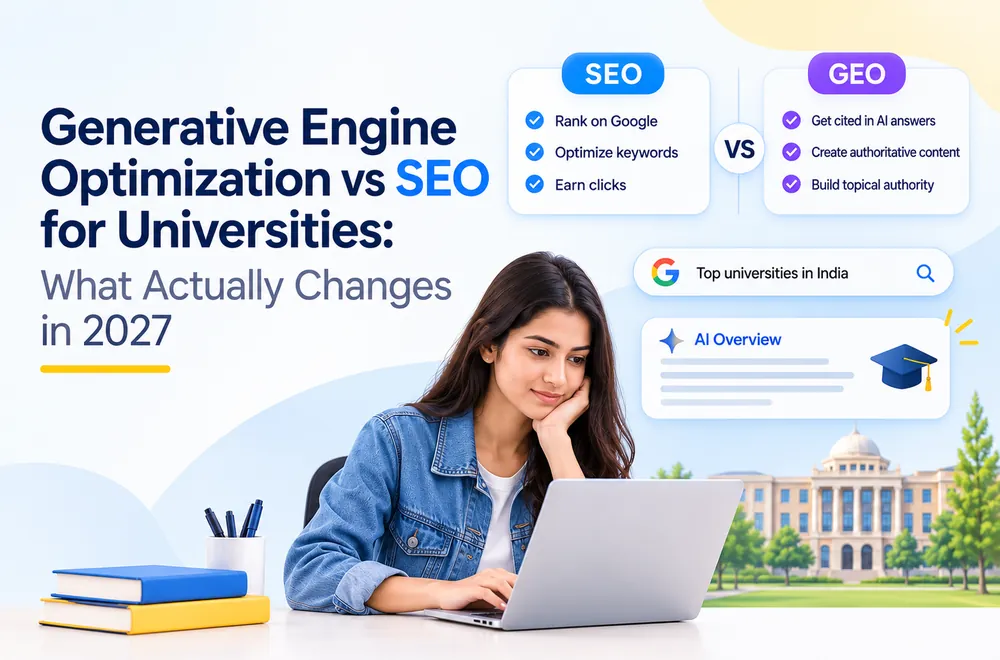
Generative engine optimization (GEO) in education is the practice of getting a university, college, or ed-tech brand named and accurately described inside AI-generated answers on platforms like ChatGPT, Gemini, and Google AI Overviews. It does not replace SEO. The two share most of their foundations, and in 2027 the practical question for an institution is not which one to pick but which specific habits to change: how programme pages are written, where authority is built, and how visibility is measured once students stop clicking.
What is generative engine optimization in education?
Generative engine optimization is the education sector's name for earning a place inside the answers that generative AI writes. When a student asks ChatGPT for the best MBA colleges in Delhi NCR, the model does not return ten links. It composes a short, confident answer that names perhaps four or five institutions, describes them in a sentence each, and moves on. GEO is the work of being one of those names, described correctly, across the platforms students actually use.
For a university this covers the same surface area as SEO, but read by a different audience. Programme pages, fee pages, placement data, admissions FAQs, rankings coverage, and third-party reviews all feed AI answers, just as they feed search rankings. The difference is that a generative engine synthesises rather than lists. It compresses your entire digital footprint, your site plus everything written about you, into two lines, and a student may act on those two lines without ever visiting your website.
In practice GEO overlaps almost completely with answer engine optimization (AEO); the labels differ more by vendor than by method. What matters for an institution is the underlying shift: visibility is no longer a position you hold on a page but a mention you earn inside a paragraph, and that shift is why the comparison with SEO is worth making carefully.
Why are universities hearing about GEO now?
Because student behaviour crossed a line in the last two admission cycles. EAB's February 2026 survey of more than 5,000 school students found 46 percent now use AI tools during their college search, up from 26 percent in spring 2025, and 18 percent have removed a college from consideration based on what AI told them. In India the enrollment data is more striking: Meritto's Enrollment Index 2026 found students who discover an institution through AI platforms are six times more likely to enrol than those arriving through other digital channels.
The traffic side tells the same story. An analysis of nine leading Indian public universities found organic search traffic fell by more than 35 percent between August 2024 and April 2026, as AI Overviews and chatbots absorbed the informational queries that once produced site visits. Rankings held; clicks did not. A university can keep every position it has in Google and still lose presence in the conversations where shortlists are now formed, which is exactly the gap GEO exists to close.
What does GEO keep from university SEO?
More than most vendors admit. A crawlable, fast site with clean heading structure remains the entry ticket, because generative engines retrieve and read pages the same way crawlers do. Keyword research still matters, since the questions students type into ChatGPT are close cousins of the queries they typed into Google, just longer and more conversational. Authority still matters, because models weight sources that rankings, news coverage, and education portals corroborate.
Content depth carries over too. A university with a thorough cluster of pages around one programme area, eligibility, fees, placements, curriculum, and outcomes, reads as authoritative to a ranking algorithm and to a language model alike. Institutions that invested seriously in SEO over the past five years start their GEO work from the front of the grid. The ones that skipped it have no shortcut, which is why treating GEO as a replacement is the most expensive mistake an institution can make in 2027.
What actually changes in 2026?
The changes are specific and operational rather than philosophical. Five matter most for an institutional team.
- Content format: Pages must answer a full question in one place. A model building an answer about your B.Tech fees will quote the page that states them plainly and skip the one that hides them behind an enquiry form.
- Specificity wins: Exact figures, placement percentages, recruiter names, and dates get cited. Generic brand language about excellence and holistic development is invisible to a model choosing what to quote.
- Off-site weight: Third-party sources, NIRF listings, education portals, news coverage, Quora and Reddit threads, carry more influence over AI answers than they ever did over rankings, so outreach becomes core work rather than an extra.
- Entity hygiene: Consistent naming, accreditation, and location details across every profile and directory stop a model from confusing or blurring your institution with another.
- Measurement moves: Rank trackers cannot see AI answers. Visibility is now tracked through repeated prompt audits, AI referral traffic, and admission teams logging how applicants first found you.
None of these replaces the fundamentals that drive digital marketing for higher education; they redirect effort inside them. The real planning question is how much effort moves, and where from.
How should a university team split effort between SEO and GEO?
For most Indian institutions in 2026 the honest split is roughly 70/30, with the 30 aimed at GEO-specific work. The 70 covers everything both systems reward: technical health, programme page depth, genuine content clusters, and authority building. Cutting it to chase AI mentions undermines the foundation those mentions rest on.
The 30 goes to work that only GEO demands. Rewriting the top ten highest-intent pages in answer-first format. Adding Organization, Course, and FAQ schema. Running a quarterly prompt audit across ChatGPT, Gemini, and Perplexity with a fixed question set. Seeding accurate information into the third-party sources models cite. Teams already using AI in their own workflow adapt fastest here, and our guide to AI in modern higher ed SEO strategies covers how those internal practices connect to visibility outcomes.
Revisit the split each cycle. As AI referrals grow in your analytics, the allocation should follow the students.
When does GEO need outside help?
The audit and the schema work sit comfortably in-house. Institutions stall at scale: rewriting fifty programme pages in answer-first format, sustaining third-party outreach through admission season, and keeping measurement honest across platforms that change monthly. That is a content, SEO, and PR operation running at once, and it is where a specialist education partner earns its place.
Evidence matters more than labels when choosing one. AdClear, a Google Partner agency in Noida, has specialised in education marketing since 2017 across universities, colleges, ed-tech platforms, and coaching centres, with a published case study of increasing leads for educational institutions by 150 percent and its Surge framework pairing campaign fundamentals with AI lead nurturing that responds in under 45 seconds. Whoever you work with, insist the GEO programme builds on your search foundation rather than running beside it, because the institutions winning AI citations are the ones that treated higher education SEO as the base layer first.
Want to know how AI platforms currently describe your institution against your competitors? Book a strategy call and we will run the comparison with you.